Task — Source Component — Tables
Tables is a data selection option that allows the creation of TDM tasks on tables only, without any association to a Business Entity. Users can select all or specific tables that are included in the DB interfaces of the chosen source environment.
The following information needs to be set for the Tables data selection option:
Lock Icons
Task fields that support runtime override have a lock icon next to their label. By default, these fields are locked — the task creator can click the lock icon to unlock a field and allow the task runner to set or override its value at execution time. See the full list of attributes available for runtime override.
Source Environment
Select a TDM environment from the drop-down list that displays available source environments. If the selected source environment is defined as containing sensitive data in the Environment window's settings, a PII icon will appear next to the selected source environment, indicating that its sensitive data is masked.
The Source Environment field has a lock icon. The task creator can unlock it to allow the task runner to select or override the source environment at execution.
Policy for Fetching Data
This setting defines whether the data needs to be extracted from the source environment or can be retrieved from the Test Data Store (Fabric). The following options are available:
All data from [source environment name] — extract the tables from the source environment.
Selected snapshot (version) — retrieve a selected data snapshot (version) created in the Test Data Store by previous task executions. The task execution does not access the source environment directly.
Note that option 1 is not available if the source environment is set with the Do not Sync option.
Tables
The task displays the source environment's active interfaces. Click the required interface to view its schemas. If needed, click a schema to view its tables. You can select tables in the task using one of the following methods:
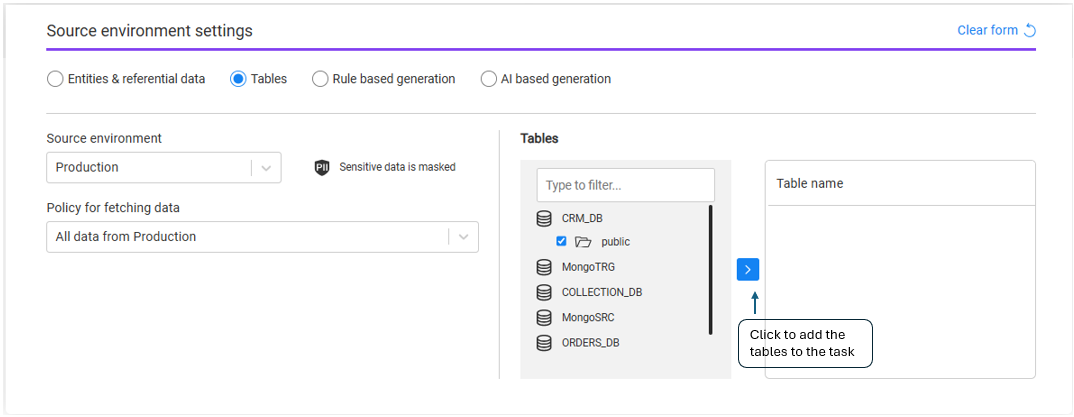
- Check the checkbox next to the schema to select all of its tables, and click the blue arrow icon to move these tables to the Table name area:
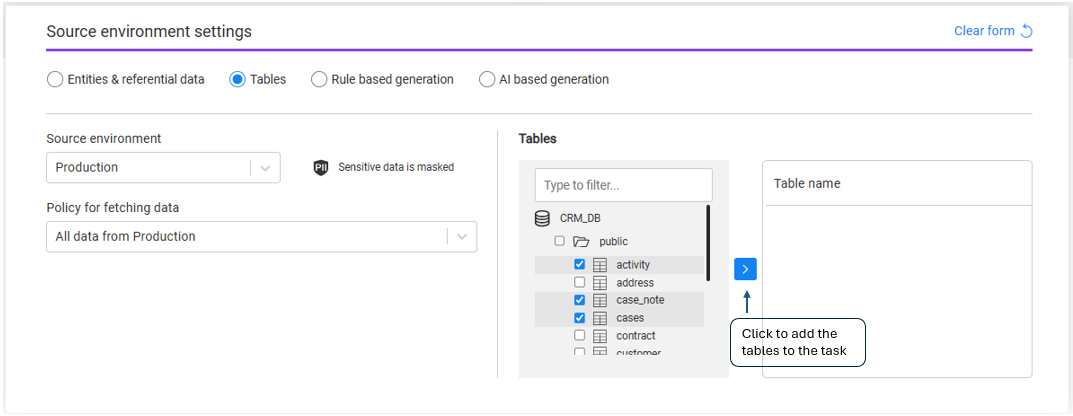
- Click the schema to view its tables, check the checkboxes of the required tables, and click the blue arrow icon to move these tables to the Table name area:
Note that the Source component defines the table list. However, a filter on the extracted records for each selected table can be added in the Subset component.
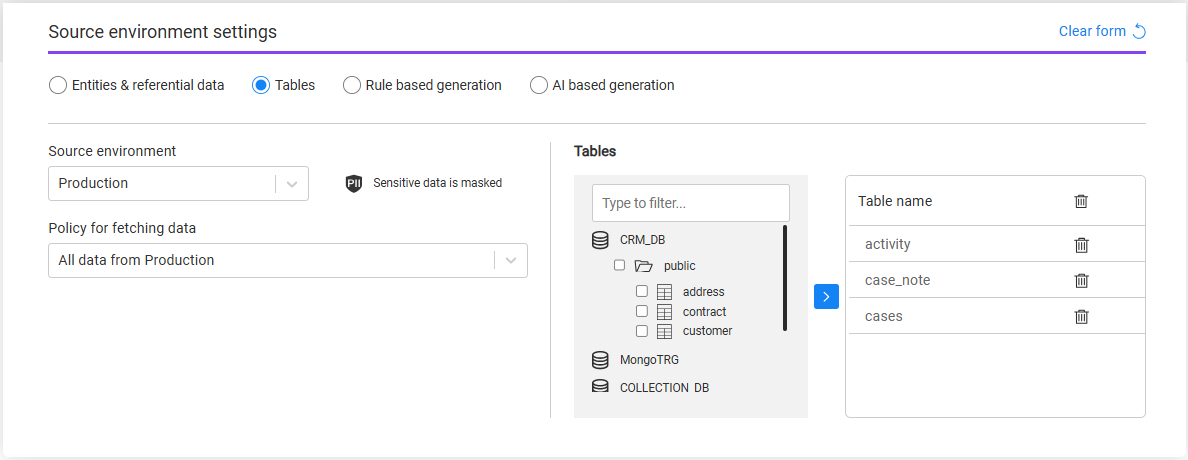
Removing selected tables: Click the trash icon next to Table name to remove all selected tables from the task, or click the trash icon next to a specific table to remove only that table from the task:
Loading pre-extracted tables: If the Policy for fetching data field is set to Select snapshot (version), each selected table displays its latest data version:
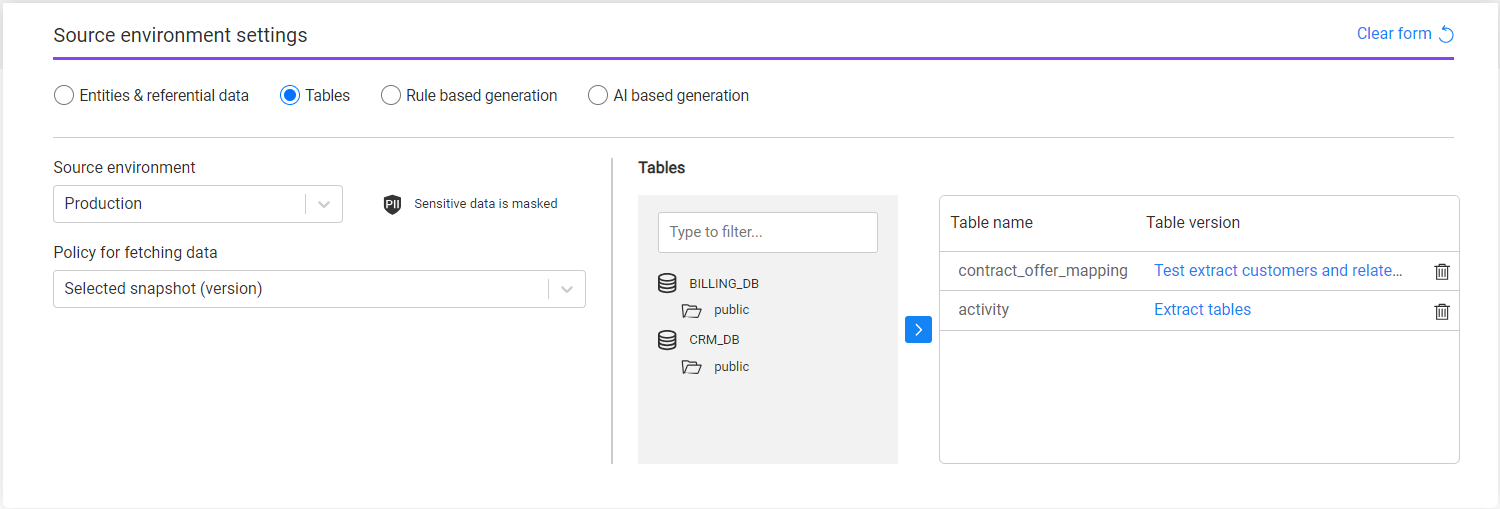
The Table version (shown in the above image) is the name of the task that extracted the table's snapshot. Upon clicking, a pop-up window appears showing all available versions (see image below), enabling the user to select an alternative table version if required:
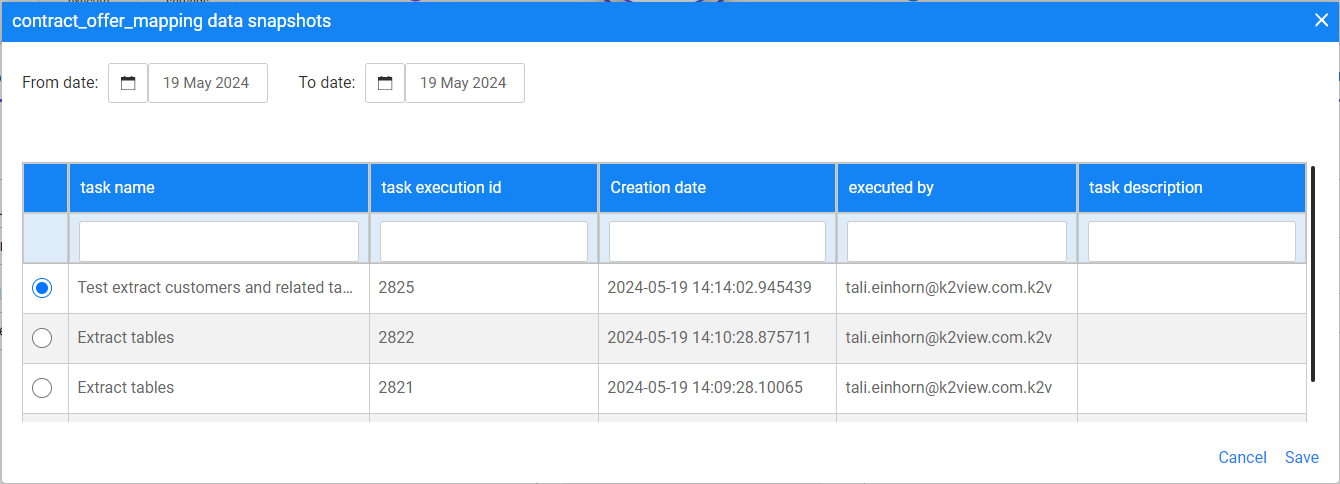
Tables - Advanced Settings
Affinity and Maximum number of Workers configuration
Starting with TDM 9.5, each interface of the selected tables supports configuration of:
Affinity
Maximum number of workers
By default, each interface gets its values from:
- The environment's system settings, if defined and if the interface is attached to the environment's system or
- The TDM and Fabric configuration values
You can override these values per interface to better control and optimize task execution behavior:
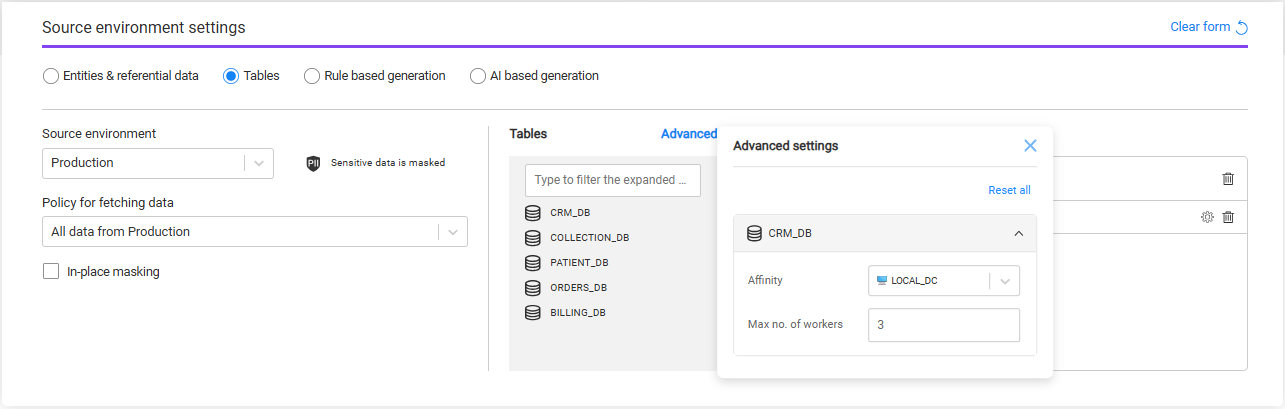
Source and Target execution behavior
You can configure Affinity and Maximum number of workers on the Target component as well.
When both Source and Target components are defined for the task (Load, Extract & Load), the task execution uses the Target affinity and Target maximum number of workers.
Click here for more details on how task execution determines the effective affinity and maximum number of workers.
Disable Table Row Count
Starting with TDM 9.5, you can disable table row count calculation during task execution to improve performance when row counts are not required.
To configure this setting, click the settings icon for the selected table to open the configuration pop-up:
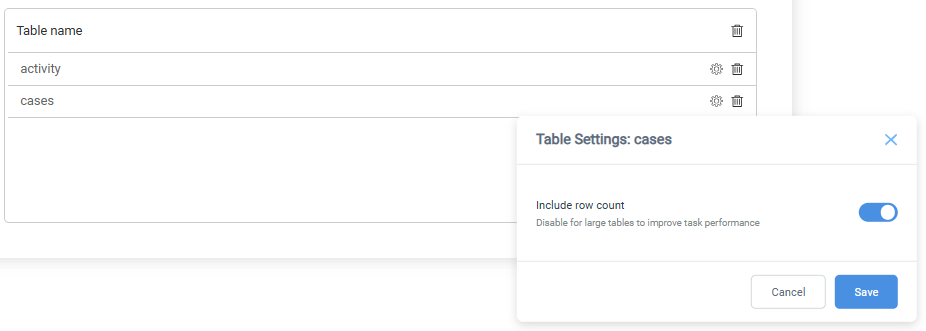
Note: You can disable or re-enable table row count only for tables that are eligible for row count, as defined in the TDM implementation.
In-Place Masking Task
Starting with TDM 9.5, a table-level task can run in-place masking, meaning that PII fields are updated directly in the source tables by replacing the original values with masked values.
Select the In-place Masking checkbox to create an in-place masking task. In this mode, the Test Data Store and Target components are disabled, since the same environment functions as both the source and the target:
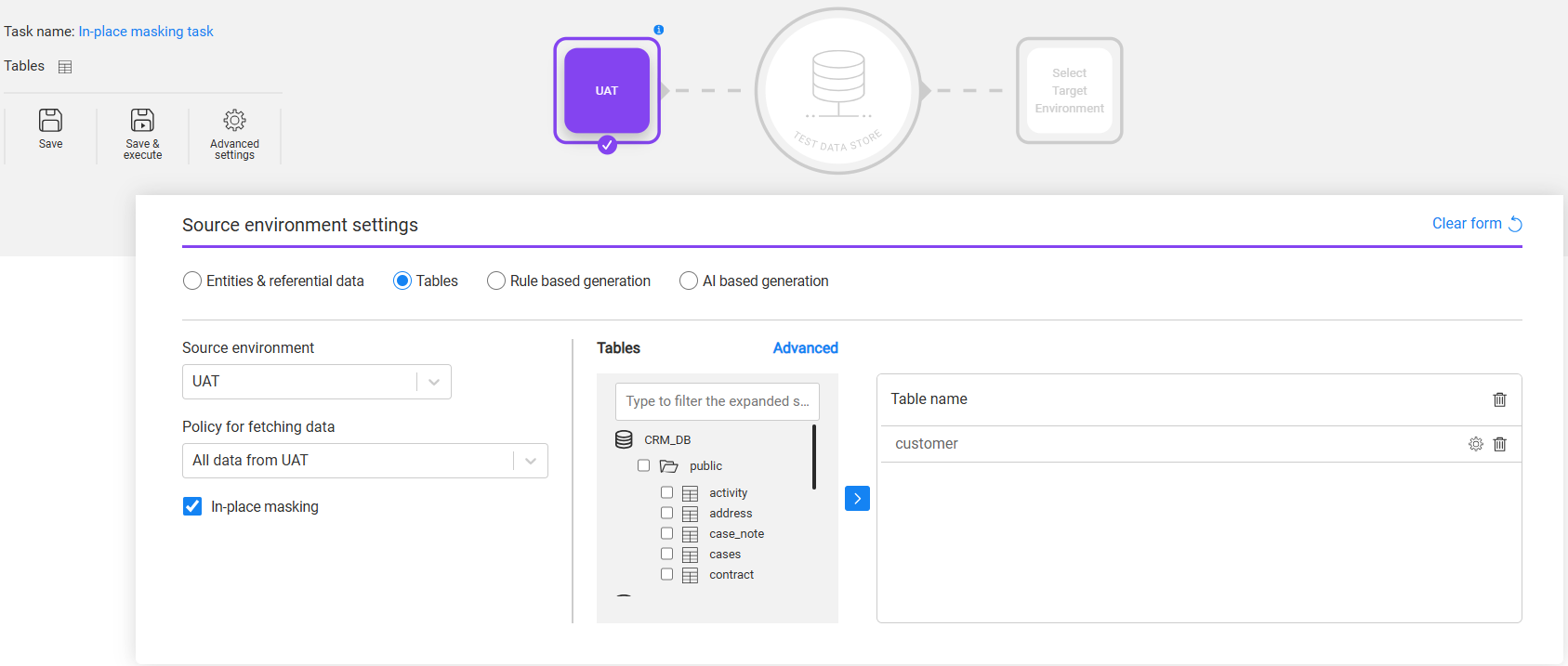
Notes:
The In-place Masking checkbox is disabled for read-only environments.
The selected environment must be defined as Both (Source and Target) for an in-place masking task.
The Policy of fetching data must be set to All data from [source environment name] for an in-place masking task.


Task — Source Component — Tables
Tables is a data selection option that allows the creation of TDM tasks on tables only, without any association to a Business Entity. Users can select all or specific tables that are included in the DB interfaces of the chosen source environment.
The following information needs to be set for the Tables data selection option:
Lock Icons
Task fields that support runtime override have a lock icon next to their label. By default, these fields are locked — the task creator can click the lock icon to unlock a field and allow the task runner to set or override its value at execution time. See the full list of attributes available for runtime override.
Source Environment
Select a TDM environment from the drop-down list that displays available source environments. If the selected source environment is defined as containing sensitive data in the Environment window's settings, a PII icon will appear next to the selected source environment, indicating that its sensitive data is masked.
The Source Environment field has a lock icon. The task creator can unlock it to allow the task runner to select or override the source environment at execution.
Policy for Fetching Data
This setting defines whether the data needs to be extracted from the source environment or can be retrieved from the Test Data Store (Fabric). The following options are available:
All data from [source environment name] — extract the tables from the source environment.
Selected snapshot (version) — retrieve a selected data snapshot (version) created in the Test Data Store by previous task executions. The task execution does not access the source environment directly.
Note that option 1 is not available if the source environment is set with the Do not Sync option.
Tables
The task displays the source environment's active interfaces. Click the required interface to view its schemas. If needed, click a schema to view its tables. You can select tables in the task using one of the following methods:
- Check the checkbox next to the schema to select all of its tables, and click the blue arrow icon to move these tables to the Table name area:
- Click the schema to view its tables, check the checkboxes of the required tables, and click the blue arrow icon to move these tables to the Table name area:
Note that the Source component defines the table list. However, a filter on the extracted records for each selected table can be added in the Subset component.
Removing selected tables: Click the trash icon next to Table name to remove all selected tables from the task, or click the trash icon next to a specific table to remove only that table from the task:
Loading pre-extracted tables: If the Policy for fetching data field is set to Select snapshot (version), each selected table displays its latest data version:
The Table version (shown in the above image) is the name of the task that extracted the table's snapshot. Upon clicking, a pop-up window appears showing all available versions (see image below), enabling the user to select an alternative table version if required:
Tables - Advanced Settings
Affinity and Maximum number of Workers configuration
Starting with TDM 9.5, each interface of the selected tables supports configuration of:
Affinity
Maximum number of workers
By default, each interface gets its values from:
- The environment's system settings, if defined and if the interface is attached to the environment's system or
- The TDM and Fabric configuration values
You can override these values per interface to better control and optimize task execution behavior:
Source and Target execution behavior
You can configure Affinity and Maximum number of workers on the Target component as well.
When both Source and Target components are defined for the task (Load, Extract & Load), the task execution uses the Target affinity and Target maximum number of workers.
Click here for more details on how task execution determines the effective affinity and maximum number of workers.
Disable Table Row Count
Starting with TDM 9.5, you can disable table row count calculation during task execution to improve performance when row counts are not required.
To configure this setting, click the settings icon for the selected table to open the configuration pop-up:
Note: You can disable or re-enable table row count only for tables that are eligible for row count, as defined in the TDM implementation.
In-Place Masking Task
Starting with TDM 9.5, a table-level task can run in-place masking, meaning that PII fields are updated directly in the source tables by replacing the original values with masked values.
Select the In-place Masking checkbox to create an in-place masking task. In this mode, the Test Data Store and Target components are disabled, since the same environment functions as both the source and the target:
Notes:
The In-place Masking checkbox is disabled for read-only environments.
The selected environment must be defined as Both (Source and Target) for an in-place masking task.
The Policy of fetching data must be set to All data from [source environment name] for an in-place masking task.