


Task — Table Subset
The table subset enables an optional filtering and sampling of the records extracted for the task's tables. The table subset is available when selecting the Tables option in the Source component, i.e., creating a task on tables only.
A filter and/or a record sampling can be added to one, several, or all of the task's tables.
Click the filter icon next to a table to open the Data subset settings window:
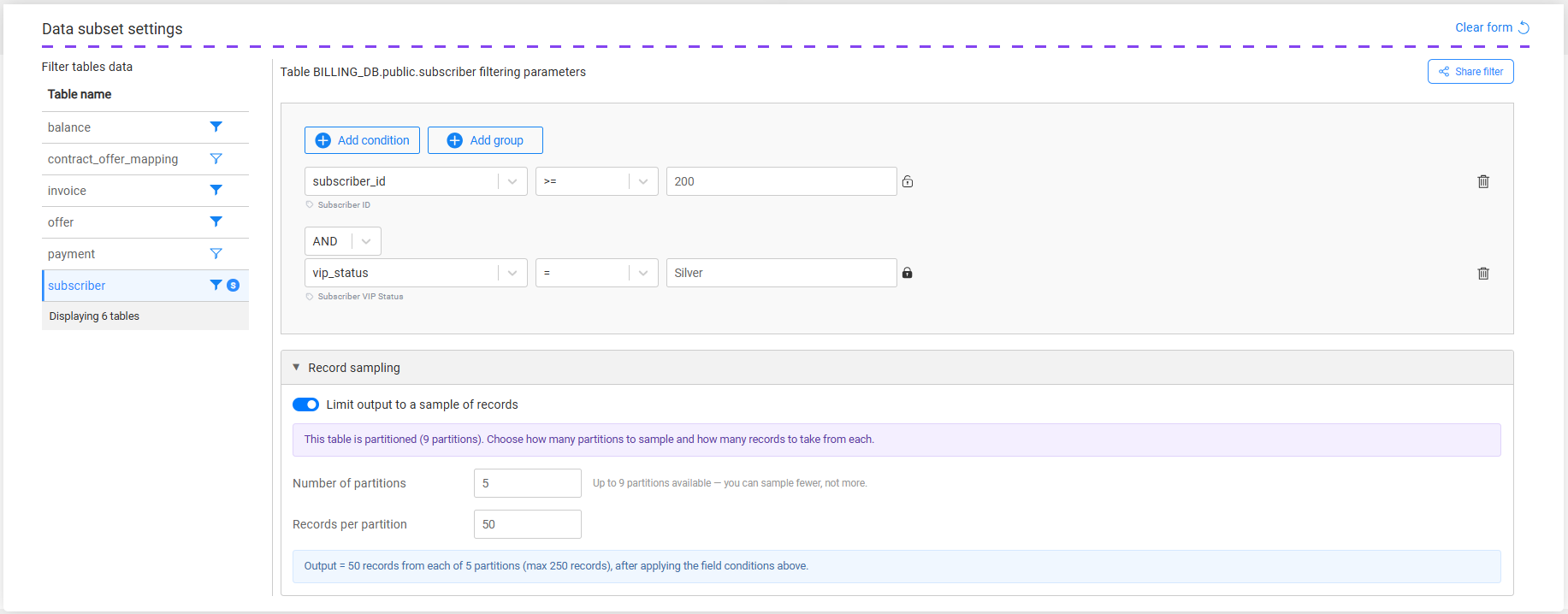
The window is split into two panels:
- Left panel — lists all the task's tables. A filled filter icon next to a table indicates that a filter has already been set for it. An S icon next to the filter icon indicates that a record sampling has been set for the table. Click a table name to view or edit its filtering parameters in the right panel.
- Right panel — displays the filtering parameters for the selected table, identified by its full name (e.g., CRM_DB.public.address). The right panel includes the following sections:
- Filter conditions — define the field conditions to filter the table's records.
- Record sampling — limit the number of records extracted from the table. See Record Sampling.
To define a filter, select a table field, an operator, and enter a value. Multiple conditions and/or groups can be added using the Add condition and Add group buttons.
Click Clear form to remove all filters across all tables.
Click Share filter to copy the filter conditions and/or the record sampling of the selected table to other tables of the task. See Shared Filters.
Field Aliases and Valid Values
Starting from TDM 10.1, the table filter displays business-friendly field names and valid values from the Catalog, making it easier to define the filter conditions:
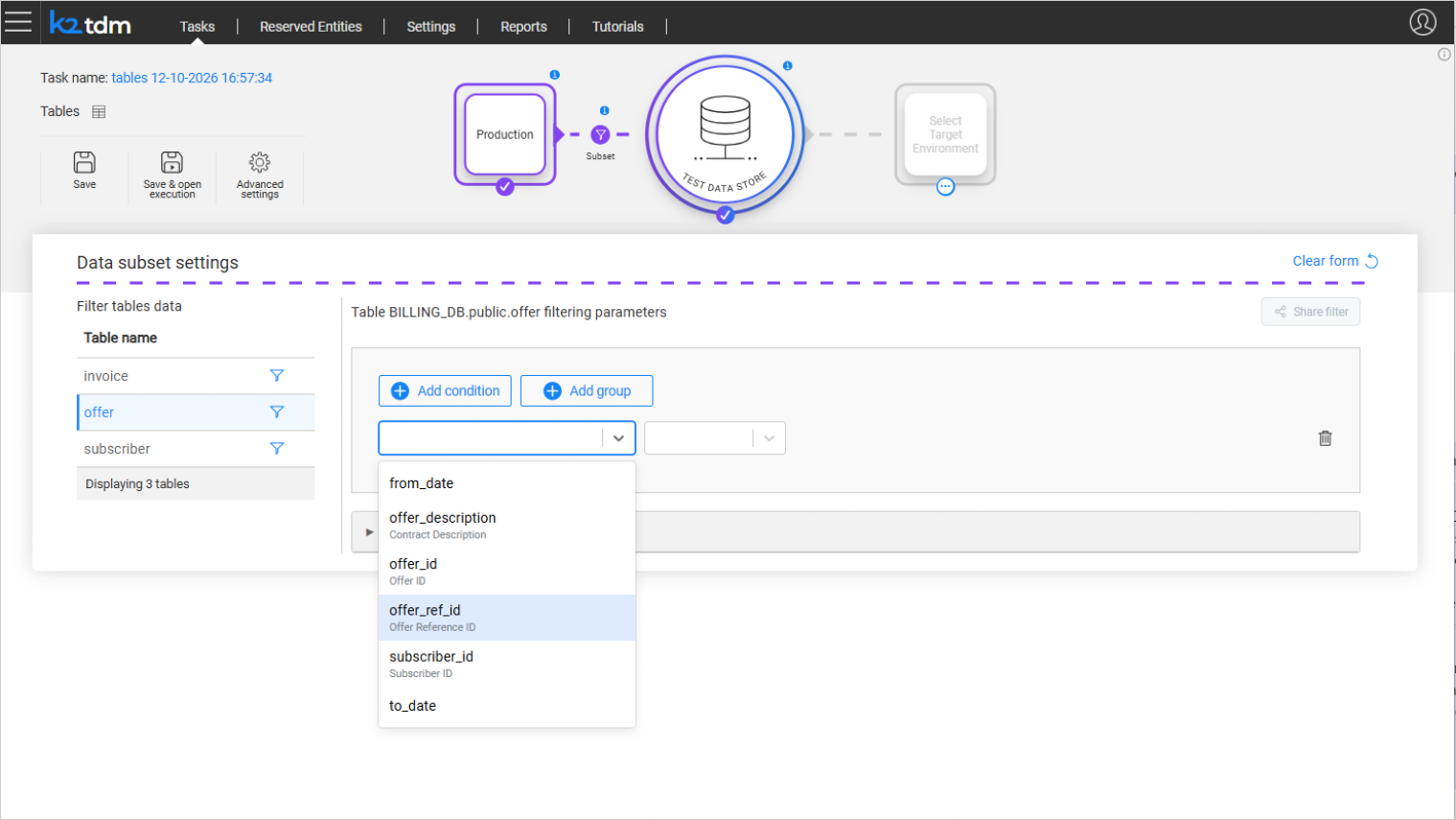
Field aliases — when a field alias (business name) is defined for a field in the Catalog, it is displayed under the field name in the fields dropdown list, as well as under the selected field in the filter condition. For example, the offer_ref_id field is displayed with its alias Offer Reference ID.
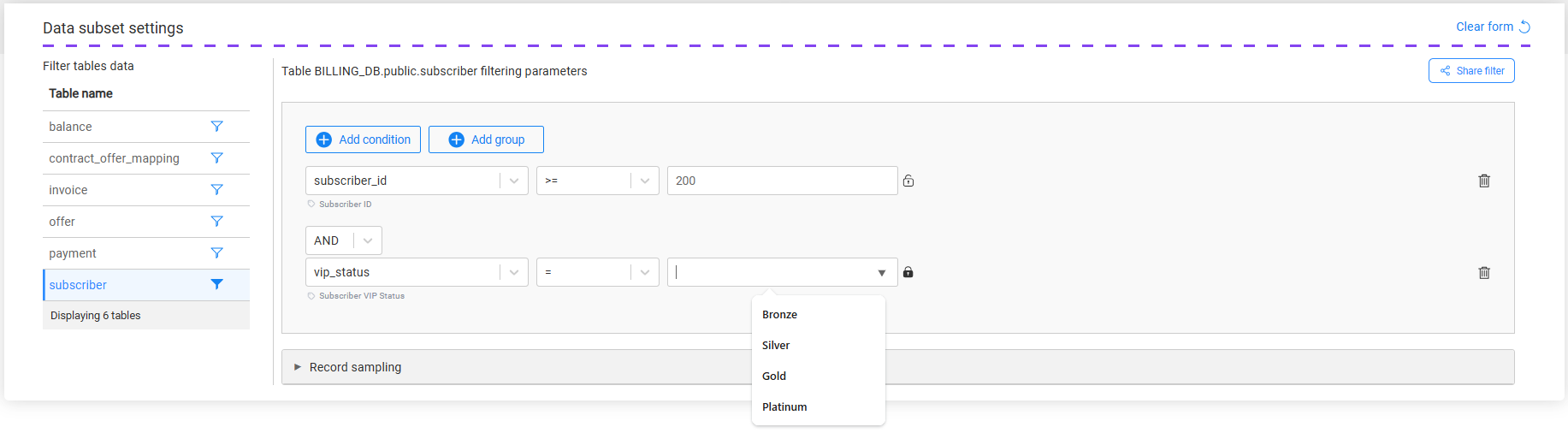
Valid values — when the Catalog holds a list of valid values for the selected field, these values are displayed in a dropdown list in the condition's value field. For example, the vip_status field displays the following valid values: Bronze, Silver, Gold, and Platinum. You can select a value from the list or type a custom value manually.
Prerequisites:
- Field aliases are defined in the Catalog using the FIELDALIAS tag on the table's fields.
- Valid values are available when the Catalog Discovery has been executed with the Option Set Analyzer enabled. The Option Set Analyzer identifies non-sensitive fields with a limited number of distinct values within a data sample and saves these values in the Catalog.
- Click here For more information about the implementation steps.
Record Sampling
Starting from TDM 10.1, you can extract a random sample of records from a table, either together with the filter conditions or without them. The sample is used to limit the number of records extracted from the table.
To set a record sampling on a table:
- Expand the Record sampling section in the right panel.
- Turn on the Limit output to a sample of records toggle. An information message displays the number of partitions of the table, for example: This table is partitioned (9 partitions).
- Populate the following settings:
- Number of partitions — the number of table partitions to sample. You can sample up to the number of the table's partitions.
- Records per partition — the number of records to take from each sampled partition.
A summary message displays the expected output. For example: Output = 50 records from each of 5 partitions (max 250 records), after applying the field conditions above.
How the sampling works:
- Sampling is partition-based, and each partition is processed independently.
- In each sampled partition, the table's SELECT statement retrieves all records that match the filter conditions (or all records, if no filter conditions are defined). The number of records read from the SELECT statement's output is then limited by the configured number of records per partition.
- The number of table partitions can be displayed based on the partition flow defined for the table in the TableLevelDefinitions MTable. This requires additional configuration. Click here for more information.
- Tables with a record sampling are indicated in the task execution window.
Notes:
- Record sampling is intended for independent tables. Applying sampling separately to related tables (tables with PK/FK relationships) may break the referential integrity of the extracted data. The task creator is responsible for using record sampling only on tables where referential integrity is not compromised.
Shared Filters
Starting from TDM 10.1, you can share the filter conditions and/or the record sampling of a table with other tables of the task in one step. For example, apply a last update date condition to all the task's tables that contain this field.
Click Share filter in the right panel of the source table to open the Share filter window. The Share filter button is enabled only when a filter or a record sampling has been defined on the selected table.
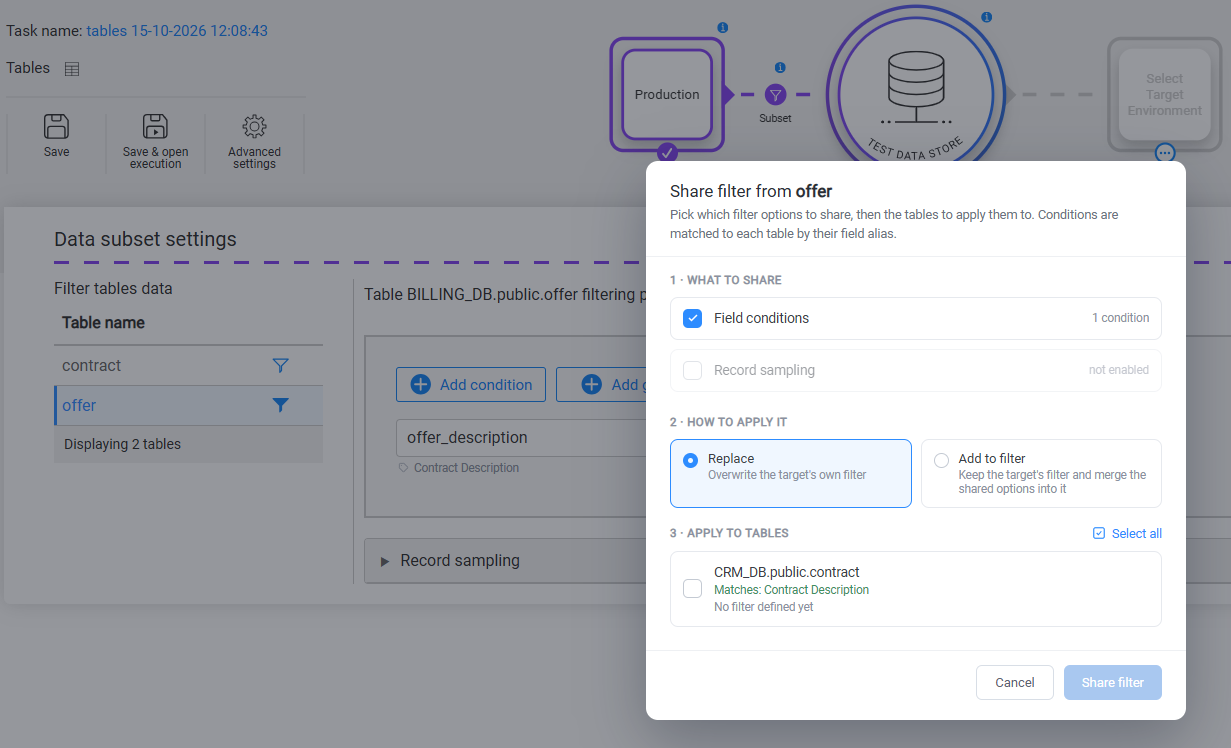
The Share filter window includes the following steps:
- What to share — select the settings to share:
- Field conditions — shares the fields that have business names (field alias).
- Record sampling — shares the record sampling settings of the source table. This option is disabled if a record sampling is not enabled on the source table.
- How to apply it — select how to apply the shared settings to the target tables:
- Replace — overwrites the target table's own filter.
- Add to filter — keeps the target table's filter and merges the shared settings into it.
- Apply to tables — lists the task's tables that the filter can be shared with. All tables are selected by default. Clear the check box of a table to exclude it, or click Remove all to clear all tables. For each table, the window displays:
- The matching field aliases, for example: Matches: Subscriber ID.
- Whether a filter is already defined on the table, for example: No filter defined yet.
Click Share with [N] tables to apply the shared settings to the selected tables.
Notes:
- Filter conditions are matched to each target table by their field alias and not by the field name, since the same field name can represent a different meaning in different tables. For example, an ID_NUM field can represent a customer, an address, or a contract.
- The shared settings are copied to the target tables. After sharing, the filter of each table can be edited independently, and future edits on the source table do not affect the target tables.
Lock Icons
Each condition has a lock icon. The task creator can lock or unlock individual conditions to control whether the task runner can modify them at execution time:
- Locked — the condition's operator and value are fixed and cannot be changed by the task runner at execution.
- Unlocked — the task runner can modify the condition's operator and/or value when executing the task.
At execution time, all filter conditions are displayed, but the task runner can only edit the unlocked ones.
Task — Table Subset
The table subset enables an optional filtering and sampling of the records extracted for the task's tables. The table subset is available when selecting the Tables option in the Source component, i.e., creating a task on tables only.
A filter and/or a record sampling can be added to one, several, or all of the task's tables.
Click the filter icon next to a table to open the Data subset settings window:
The window is split into two panels:
- Left panel — lists all the task's tables. A filled filter icon next to a table indicates that a filter has already been set for it. An S icon next to the filter icon indicates that a record sampling has been set for the table. Click a table name to view or edit its filtering parameters in the right panel.
- Right panel — displays the filtering parameters for the selected table, identified by its full name (e.g., CRM_DB.public.address). The right panel includes the following sections:
- Filter conditions — define the field conditions to filter the table's records.
- Record sampling — limit the number of records extracted from the table. See Record Sampling.
To define a filter, select a table field, an operator, and enter a value. Multiple conditions and/or groups can be added using the Add condition and Add group buttons.
Click Clear form to remove all filters across all tables.
Click Share filter to copy the filter conditions and/or the record sampling of the selected table to other tables of the task. See Shared Filters.
Field Aliases and Valid Values
Starting from TDM 10.1, the table filter displays business-friendly field names and valid values from the Catalog, making it easier to define the filter conditions:
Field aliases — when a field alias (business name) is defined for a field in the Catalog, it is displayed under the field name in the fields dropdown list, as well as under the selected field in the filter condition. For example, the offer_ref_id field is displayed with its alias Offer Reference ID.
Valid values — when the Catalog holds a list of valid values for the selected field, these values are displayed in a dropdown list in the condition's value field. For example, the vip_status field displays the following valid values: Bronze, Silver, Gold, and Platinum. You can select a value from the list or type a custom value manually.
Prerequisites:
- Field aliases are defined in the Catalog using the FIELDALIAS tag on the table's fields.
- Valid values are available when the Catalog Discovery has been executed with the Option Set Analyzer enabled. The Option Set Analyzer identifies non-sensitive fields with a limited number of distinct values within a data sample and saves these values in the Catalog.
- Click here For more information about the implementation steps.
Record Sampling
Starting from TDM 10.1, you can extract a random sample of records from a table, either together with the filter conditions or without them. The sample is used to limit the number of records extracted from the table.
To set a record sampling on a table:
- Expand the Record sampling section in the right panel.
- Turn on the Limit output to a sample of records toggle. An information message displays the number of partitions of the table, for example: This table is partitioned (9 partitions).
- Populate the following settings:
- Number of partitions — the number of table partitions to sample. You can sample up to the number of the table's partitions.
- Records per partition — the number of records to take from each sampled partition.
A summary message displays the expected output. For example: Output = 50 records from each of 5 partitions (max 250 records), after applying the field conditions above.
How the sampling works:
- Sampling is partition-based, and each partition is processed independently.
- In each sampled partition, the table's SELECT statement retrieves all records that match the filter conditions (or all records, if no filter conditions are defined). The number of records read from the SELECT statement's output is then limited by the configured number of records per partition.
- The number of table partitions can be displayed based on the partition flow defined for the table in the TableLevelDefinitions MTable. This requires additional configuration. Click here for more information.
- Tables with a record sampling are indicated in the task execution window.
Notes:
- Record sampling is intended for independent tables. Applying sampling separately to related tables (tables with PK/FK relationships) may break the referential integrity of the extracted data. The task creator is responsible for using record sampling only on tables where referential integrity is not compromised.
Shared Filters
Starting from TDM 10.1, you can share the filter conditions and/or the record sampling of a table with other tables of the task in one step. For example, apply a last update date condition to all the task's tables that contain this field.
Click Share filter in the right panel of the source table to open the Share filter window. The Share filter button is enabled only when a filter or a record sampling has been defined on the selected table.
The Share filter window includes the following steps:
- What to share — select the settings to share:
- Field conditions — shares the fields that have business names (field alias).
- Record sampling — shares the record sampling settings of the source table. This option is disabled if a record sampling is not enabled on the source table.
- How to apply it — select how to apply the shared settings to the target tables:
- Replace — overwrites the target table's own filter.
- Add to filter — keeps the target table's filter and merges the shared settings into it.
- Apply to tables — lists the task's tables that the filter can be shared with. All tables are selected by default. Clear the check box of a table to exclude it, or click Remove all to clear all tables. For each table, the window displays:
- The matching field aliases, for example: Matches: Subscriber ID.
- Whether a filter is already defined on the table, for example: No filter defined yet.
Click Share with [N] tables to apply the shared settings to the selected tables.
Notes:
- Filter conditions are matched to each target table by their field alias and not by the field name, since the same field name can represent a different meaning in different tables. For example, an ID_NUM field can represent a customer, an address, or a contract.
- The shared settings are copied to the target tables. After sharing, the filter of each table can be edited independently, and future edits on the source table do not affect the target tables.
Lock Icons
Each condition has a lock icon. The task creator can lock or unlock individual conditions to control whether the task runner can modify them at execution time:
- Locked — the condition's operator and value are fixed and cannot be changed by the task runner at execution.
- Unlocked — the task runner can modify the condition's operator and/or value when executing the task.
At execution time, all filter conditions are displayed, but the task runner can only edit the unlocked ones.
